Nobel Prize for Physiology or Medicine - 2025

The 2025 Nobel Prize for Physiology or Medicine has been awarded to Drs Mary Brunkow, Fred Ramsdell and Shimon Sakaguchi for their discovery of fundamental knowledge on how the immune system is controlled.

A properly working immune system recognises and destroy pathogens - viruses, bacteria, and fungi - without destroying your own cells. If the immune system does get out of control and targets your own cells it can cause diabetes, rheumatoid arthritis, multiple sclerosis, and other autoimmune diseases.

The cells at the heart of this story are T-cells. The thymus gland, an organ that is the middle of your upper chest, is the first way that these out-of-control T-cells are removed. If they react with human cells in the thymus they are destroyed. Dr Sakaguchi did experiments where he removed the thymus of mice just after they were born. He found that this caused the mice to develop autoimmune diseases, this made sense because without a thymus the the out of control T-cells were not removed. He then injected these same mice that did not have a thymus with blood from adult mice. The injected mice did not develop autoimmune diseases. This meant that something in the blood was able to regulate these out of control T- cells. Dr Sakaguchi was able to determine that these were a special type of T-cell called a CD25+ T-cell. These T-cells must be regulating and suppressing the out of control T-cells.

Dr Brunkow and Ramsdell’s research focused on understanding gene mutations in mice. They discovered the gene mutation of a strain of mice that suffered from autoimmune diseases. This gene was Foxp3. Mutations in the equivalent gene in humans also caused autoimmune disease.

Dr Sakaguchi then determined that the Foxp3 was involved in the development of the CD25+ T-cells. With a mutated Foxp3, the CD25+ cells didn’t develop normally and they weren’t able to destroy the out of control T-cells and autoimmune disease was the result.

Their research, that started nearly 30 years ago, is now being turned into therapies. Science takes a long time but is incredibly powerful.

Read more at the Nobel Prize website

Justin Yarrow
Jane Goodall Colouring Page

It’s a sad day to learn of Jane Goodall’s passing. With seemingly unlimited energy at 91, she was advocating for nature, wildlife, humanity and, most of all , hope, until the very last day.

To honour her amazing legacy, one that undoubtably launched thousands of careers in wildlife conservation and animal behaviour, we are resharing our colouring pages that are free to download as A4 or 8.5x11s.

Learn more about why she is a hero to so many and how her work will continue through the Jane Goodall Institute. Looking for a film to watch that tells her story and her pioneering work at Gombe. This YouTube video is fantastic.

Other SuperScientists colouring pages as well as posters, comics and more are free to download here.

Justin Yarrow
In Thailand and More

Our animation short, ”SuperScientists - Origins” will be seen by audiences in Thailand, Burkina Faso, South Africa, Namibia, Cameroon, Brazil, Indonesia, the Philippines, Malaysia, and Singapore through the Goethe Institute Science Film Festival. It will even get dubbed into a few different languages 🤙

Of 1503 films from 110 countries ours made the cut of 123 films in the festival. We can't wait for people across the world to see our little film and learn about some of the awesome science in South Africa.

Justin Yarrow
SuperScientists in Huisgenoot!

We were featured in a lovely two page spread (just look at those layout skills) in Huisgenoot, South Africa’s most popular magazine by circulation. Lovely to see it and hear from Afrikaans speaking friends that it was a lekker article.

Justin Yarrow
Agents of Disinformation

It’s not that we wish that there were baddies out there, though they do make for better stories, but as we all know there are all sorts of agents in the world fighting against the truth and science.

Here are just a few of the things we need to watch out for - The Washer (green washing and more), the Beguiler (bright and shiny with a silver tongue, telling a story that isn’t true), Miss Information (like it and share it but don’t read it or scrutinize it), Little Prince What About (he thinks there’s two sides to every argument no matter what the evidence says, but what about…) and The Straw Man (just waiting for you to prove your point by knocking down this straw man of an example).

More to come with these in the future hopefully. Disinformation and misinformation aren’t going anywhere!

Justin Yarrow
Dr Keneiloe Molopyane in Nature

A great article about Keneiloe in the fabulous series by Nature “Where I Work”. The author, Raeesah Chandlay,-reached out to us to use art for the article, but we had no idea that this would be the title. It’s very cool and I think just speaks to how the idea of SupersScientists resonates with people.

Read it here!

Justin Yarrow
A New Dino Museum in South Africa!

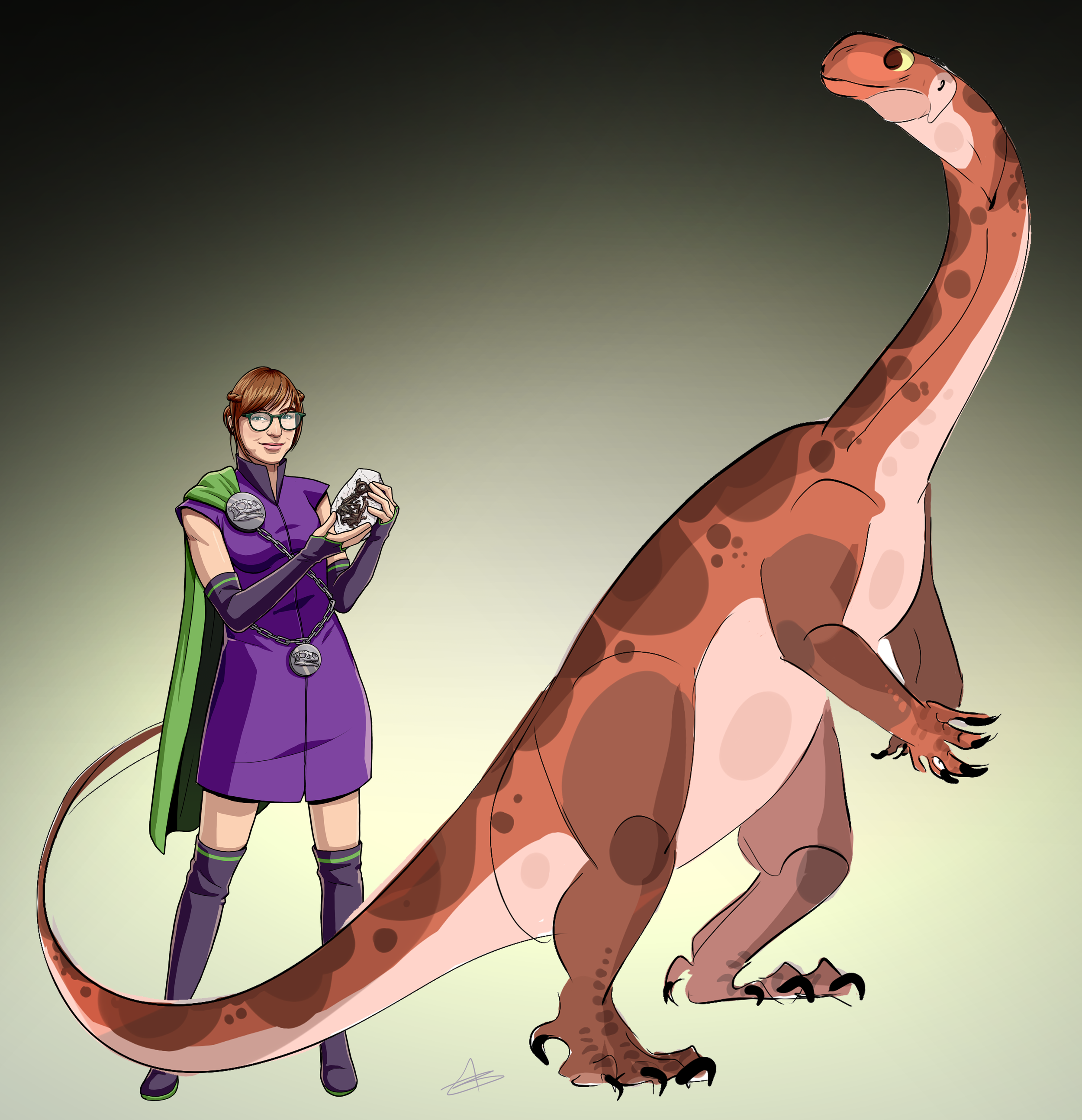
A new dinosaur museum, the Kgodumodumo interpretative centre, just opened last month in the Golden Gate Highlands National Park in Free State. The area has been, and continues to be, a rich site for dinosaur fossils. One of the stars of the centre is Massospondylus, a dinosaur depicted below (more to proper scale on the right) that was first discovered in 1854 in SA and was one of the earliest dinosaurs named - South Africa’s palaeo cred goes waaaaay back.

Dr Kimi Chapelle, aka Dinova is one of the lucky palaeontologists who has been able to study this dino, in particular its fossilised eggs and embryos. She was also the lead scientist on the development of the museum! Check it out next time you're in the Clarens area.

Download FREE colouring pages that feature Kimi and other palaeoscientists to get you in the mood before you go.

Thanks to GENUS Palaeoscience for the initial funding to make Kimi's character.

Art by Clyde Beech and Natalia Jagielska

Justin Yarrow
w/k - Between Science & Art (it's like we were made for this journal)

We had the pleasure of sharing the story of SuperScientists in a recent article in the journal - w/k- Between Science and Art. Interviewed by Crystal-Leigh Clitheroe and Anna-Sophie Jürgens of Australia National University, Justin Yarrow and Clyde Beech talked about how the project came to be, what’s involved, and the art that makes it shine. It’s a great summary of the work we’ve done and why it resonates with kids. A big thanks to Crys for reaching out to make this happen!

Justin Yarrow